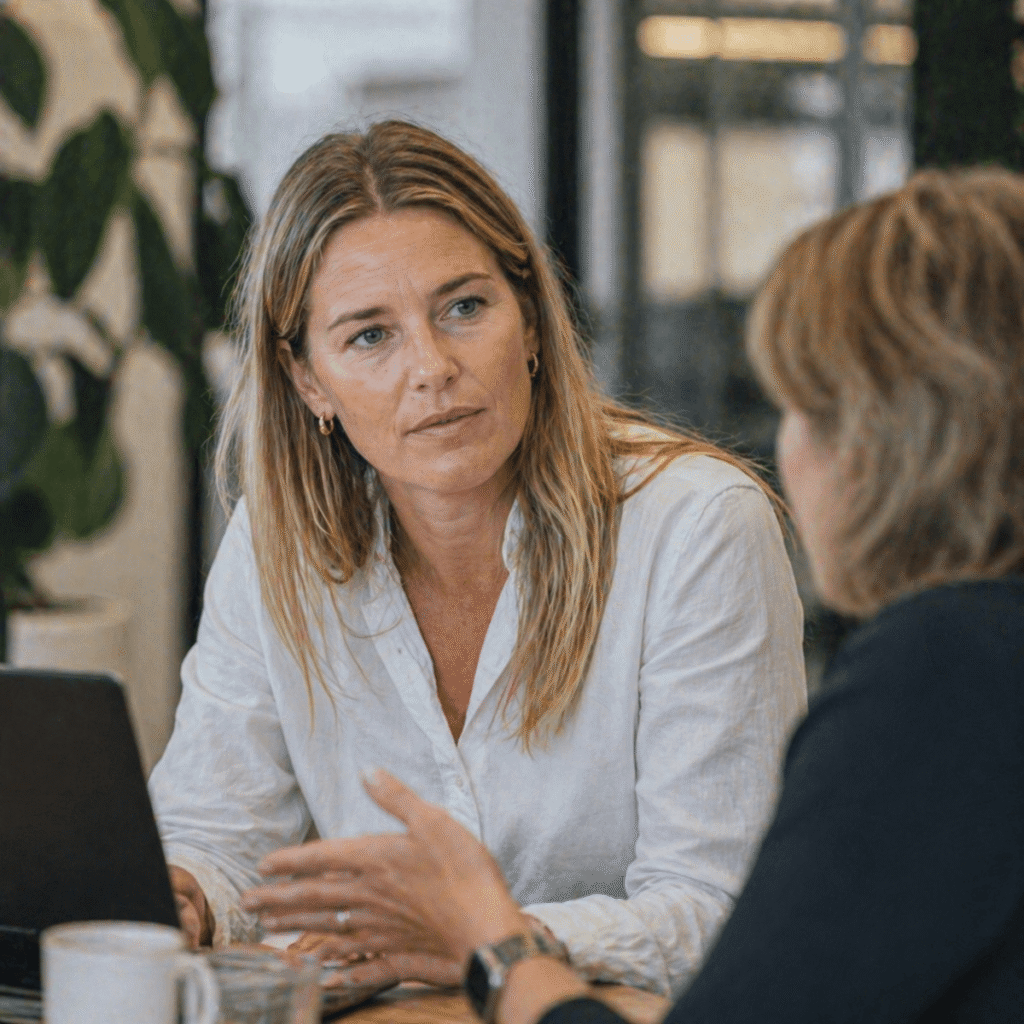
Effective communication, influential communication, you’ve probably come across these terms more than once in your professional life. But what do they actually mean? And more importantly, how can you develop these skills and use them effectively at work?
Mandy Tilleman, one of our trainers and an expert in communication and assertiveness, shares her insights.
Effective communication and influence
“In my view, effective communication and influential communication are almost the same,” Mandy begins. “When you communicate effectively, you are aware of the situation, what is needed, what you want, who you are, who the other person is, and what they want.
“This awareness allows you to communicate in a way that is both appropriate and effective in that moment. When you do this, you naturally become more influential. In other words, communication is about achieving the desired effect for both yourself and the other person.”
However, exercising that influence, steering a conversation towards a satisfying outcome—is not always easy. Many professionals face communication challenges in their work. They may struggle to get their ideas across, fail to gain support for their proposals, find it difficult to set boundaries, or, on the other hand, be too direct and goal-oriented, putting relationships under strain.
Developing your communication skills can help you navigate these challenges and become a more effective communicator.
Developing your communication skills: what’s in it for you?
When you start improving your communication skills, you’ll quickly notice that you become more confident and articulate. “During a training session, you’ll practise different communication styles in a hands-on way,” Mandy explains. “We use the Influence Model® as a foundation. This provides the theoretical framework, so you understand what you’re learning, what you’ll be practising, and why it matters. From there, you’ll work on real-life challenges, such as how to clearly express what you want in a conversation.
You’ll also practise skills like presenting a proposal effectively or getting others on board with your ideas. The training gives you practical tools to shape your communication and express yourself with clarity.”
Beyond just improving how you communicate, the real value lies in understanding behaviour, both your own and others’. “You become more aware of what you want in a conversation, but also of what the other person wants,” Mandy continues. “For example, you and a colleague might walk into a meeting with completely different goals, and learning to recognise this earlier can make all the difference.
By training yourself to be more aware, you become more effective in conversations and better at aligning with others. And don’t forget, everything you learn in communication training as a professional can also be applied in your personal life!”
Where effective communication begins
It’s clear that strong communication helps you move forward. But how do you know when you’re truly communicating effectively? “The key to good communication is knowing what you want, but also understanding what the other person wants,” Mandy explains. “In any conversation, there is a sender and a receiver.
The more aligned you are with the other person, the more effective your communication will be. So before you focus on practical skills like phrasing your message clearly, it’s important to first understand the nature of your relationship with the other person and what both of you are trying to achieve.”
Mandy elaborates: “Imagine you’re in a meeting and you want to get people on board with your idea. First, ask yourself: what does that actually mean to you? How do you define ‘getting people on board’? You might say that it means people should feel energised. But what does that really look like? After breaking it down, you may realise that what you actually want is for people to be enthusiastic about your idea. Once you’ve identified this goal, you can choose the right communication styles and techniques to guide the meeting towards that outcome.”
A goal could also be to understand the other person better or to reduce resistance from colleagues. Your objective determines which communication style will be most effective. In many cases, switching between different styles within the same conversation is the best approach to reach a shared goal. Developing this awareness is a crucial step in becoming a more effective communicator.
Learning to communicate effectively
Whether you’re in a leadership role or not, effective and influential communication strengthens your position and improves collaboration with colleagues. You become more self-aware, recognise different behaviours, and express yourself more clearly. The result? You can adapt your communication style to different situations and achieve more.
In our communication training programmes, you’ll actively work on improving your skills. Guided by experienced trainers and using the Influence Model®, you’ll gain practical tools and insights that you can apply immediately.
Influential people know how to “read” a situation and choose their behaviour intentionally. The Influence Model® gives you a clear framework to analyse interactions, recognise different influence approaches, and select the style that fits the moment. It helps you communicate in a way that achieves results while maintaining strong relationships.
Our programmes are built around your goals and real challenges. For in-company groups, we design tailored training together with your organisation, ensuring the content fits your context, culture, and development needs. Every element is shaped to make learning relevant and immediately applicable.
Your personal online learning environment - the Hub - supports your development before, during, and after the programme. You complete an intake, track your progress, revisit key concepts, and explore additional learning topics. The Hub helps you stay intentional and committed to your growth.

No long theory blocks - you learn by doing. Through intensive practice and real workplace cases, you apply new behaviour immediately and receive focused feedback from expert trainers.All TIC trainers have extensive real-world experience and complete over 1,000 training hours before leading groups independently.